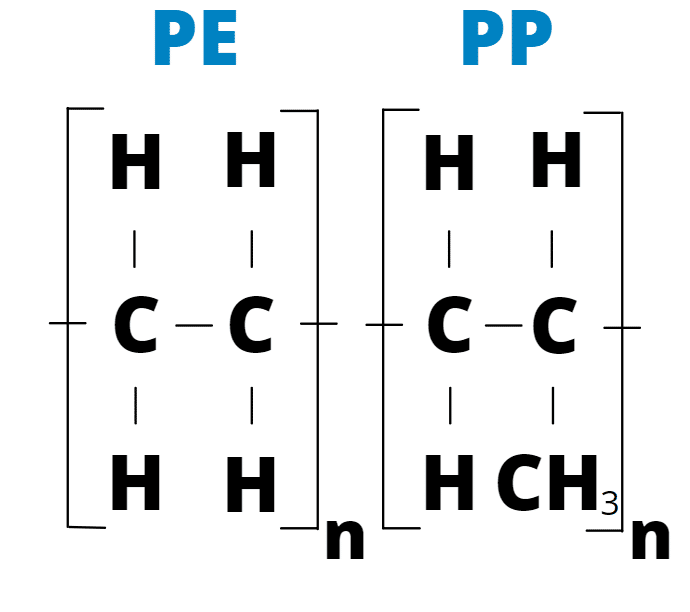
For more than 70 years, we have been using Polypropylene (PP) from the Polyolefin family to manufacture most of our cases, boxes, suitcases, and small cases.
Injection-molded, either opaque or transparent, it offers many advantages for our cases and suitcases:
Finally, Polyethylene (PE) foam is used to create certain internal inserts.
The appearance of polyolefins is milky white, with a waxy feel (except for transparent PMP, which is amorphous). Polyolefins are opaque at high thicknesses and transparent in thin films. Although they are often used as containers or packaging, polyolefins are not completely impermeable to water, air, or hydrocarbons; however, this depends on time and the acceptable amount of loss.
At room temperature (23°C), PE and PP, which are partially crystalline, are above their glass transition temperature, so their amorphous phase is rubbery. The glass transition temperature of PP is very close to room temperature. LDPE (low-density polyethylene) is, at room temperature, more prone to creep than HDPE (high-density polyethylene) and PP (which are more crystalline). Polyolefins are very sensitive to molecular orientation, meaning that mechanical properties are improved when macromolecules have been oriented in the direction of the applied stress. For these crystalline polymers, notches must be avoided, as they are detrimental to impact resistance. The paraffinic nature of polyethylene (especially HDPE) makes it a material with good friction properties.

Polyolefins have very good chemical stability. At temperatures below 60°C, they are practically insoluble. They are not attacked by acids (except oxidizing acids), bases, or saline solutions. They are insoluble in water and are in fact rather hydrophobic. They are recognized as suitable for food-contact applications. Polypropylenes are sensitive to hydrocarbons. In their natural state, polyolefins are very sensitive to ultraviolet (UV) radiation in the presence of oxygen (air), but effective photostabilizers exist, such as carbon black (black pigment).
Polyolefins are excellent insulators, which explains their tendency to build up static electricity. They have very high resistivity and high dielectric strength. Their low dielectric loss factor (tan δ), which represents the energy lost and converted into heat in the dielectric, prevents high-frequency welding.
PE and PP continue to burn even in the absence of the initiating flame, with a bluish flame, and they “drip.” In incomplete combustion (fire), carbon monoxide and small quantities of hydrocarbons are produced. Polyolefins are generally classified as HB according to UL94, but some flame-retardant grades of PP can be V0 or V2. The transition at the glass transition temperature is less noticeable as the polymer becomes more crystalline, as is the case with HDPE and PP.
Stability is independent of moisture absorption (low < 0.2%) due to their hydrophobic nature. These highly crystalline polymers therefore exhibit significant shrinkage during molding.
In general, polyolefins have a surface to which adhesion is difficult; however, each producer offers solutions and surface treatments for printing, painting, marking, or even vacuum metallization. Polyolefins have a pleasant feel. Certain copolymer grades are specifically offered for “soft-touch” applications (handles, grips, etc.).
Polyolefins are very difficult to bond. Surface preparations such as flame treatment (slight oxidation) or chemical etching must be used. Welding by infrared, contact, ultrasound, or hot air does not pose any problems. Induction welding (high frequency) is directly inapplicable because the energy is dissipated in the material and does not heat it. This drawback can be overcome by embedding a metal insert in the material. The heating of this metal along a joint plane will serve to melt the polyolefin to be welded.
Physico-chemical characteristics and parameters of material transformation.
Information on safety precautions to be taken during handling and in the event of an incident.
List of substances subject to authorisation.
Document issued by an American laboratory (UL) guaranteeing the composition, performance and manufacturing method of the material.
Californian law designed to inform end customers of the presence and related risk of a substance contained in a list.
Assessment of the time taken for a leak to appear if a substance on the RoHS list is contained in the part.
Our team is at your disposal for any regulatory questions you may have on PMMA or the other materials we use. If you have any questions or require any of the certificates mentioned above, please contact us using the questionnaire below.